
In Australia, the number of deaths per annum is likely to increase by around 1% by 2030 up to 7% by the end of this century due to global heating. The extra deaths will mostly be at older age groups, and among those who find it harder to shelter from heat. There are likely to be other climate related reasons death rates will increase – extra pollution from fires, more tropical diseases, natural disasters – not included in those extra deaths.
Will climate change affect mortality?
Particularly if you live in a temperate climate, many people think of hotter days as good for health. And in the whole world right now, more people die from extreme cold than heat. But too much heat is dangerous, so what is likely to happen as climate change increases daily temperatures, and the frequency of heatwaves?
It’s not that easy to find out, partly because most deaths that occur in heatwaves don’t have heat mentioned on the death certificate. Hannah Ritchie (from our world in data) explains:
Think about someone dying from extreme temperatures. You probably pictured someone passing out from heat stroke or dying from hypothermia. But this is not how most people die from “heat”. They die from conditions such as cardiovascular or kidney disease, respiratory infections, or diabetes.
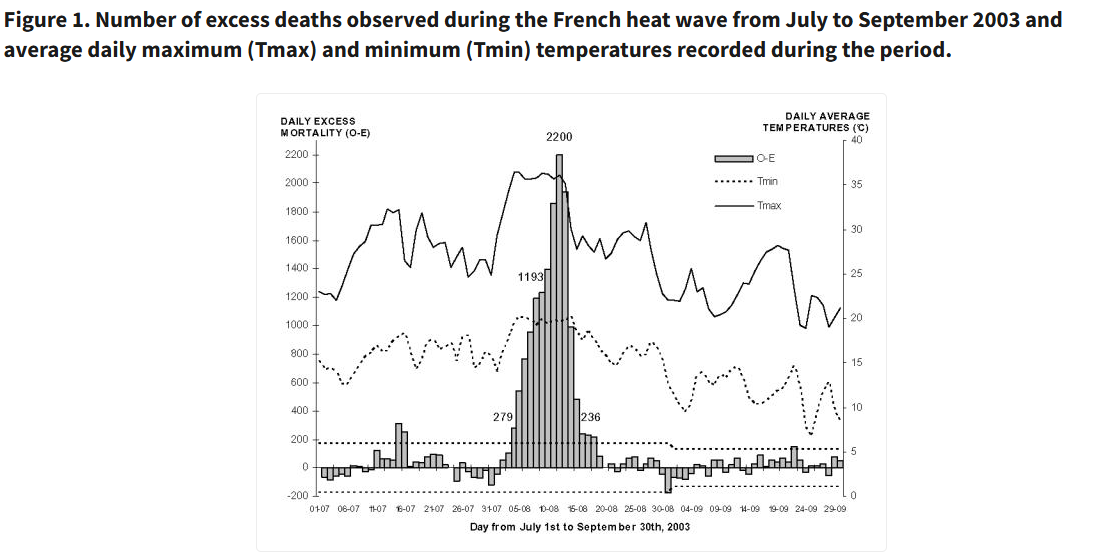 The first time I recall seeing this phenomenon was in 2003, during a massive heatwave in Europe. It was estimated by a French study, that in France, 15,000 excess deaths were observed. You can see this effect in the massive spike in deaths in the graph here – over a 10-15 day period. The graph doesn’t show any particularly dramatic reduction in the following weeks, so those deaths were not just in the very ill who were close to death.
Excess mortality at home and in retirement institutions was greater than that in hospitals. The mortality of widowed, single and divorced subjects was greater than that of married people. Deaths directly related to heat, heatstroke, hyperthermia and dehydration increased massively. Cardiovascular diseases, ill-defined morbid disorders, respiratory diseases and nervous system diseases also markedly contributed to the excess mortality. The geographic variations in mortality showed a clear age-dependent relationship with the number of very hot days.
And one of the interesting things about that heatwave was that the worst excess mortality wasn’t necessarily in the hottest countries, it was in the countries (like France) that weren’t used to heatwaves. So an extra 10 degrees of heat hit people hard when they didn’t have air conditioning, for example, or had houses that were set up for cold weather rather than hot weather. And in a heatwave, the population wasn’t used to being careful – drinking more, keeping indoors in the hottest part of the day.
Since that horrific experience, many European countries have taken big steps to help people in heatwaves – setting up cold shelters, etc. But mortality is still increased in a heatwave, even in countries with experience. And climate change will add more heatwaves, so what will happen to mortality?
The best research I have found is a 2021 paper – The burden of heat-related mortality attributable to recent human-induced climate change. This analyses deaths compared with heat records in 44 different countries over the period 1991 to 2018, and attributes some of those deaths to excess heat. It then further attributes a portion of those deaths to climate change induced excess heat. The graph here, from Our World in Data, shows some selected countries, including Australia. showing that in the hotter months, we are already getting around 0.6% extra deaths due to climate change related heatwaves, or 300-350 extra deaths.
Then a different set of researchers took that analysis, and extrapolated it out to 2030, 2050 and 2090. Our World in Data repackages this in the same analysis. In Australia, they concluded that heat related deaths would increase by 7.68 per 100,000 people by 2030, 20.39 by 2050, and 49.93 by 2090. Deaths per 100,000 people in 2024 in Australia was 688.4, so that’s an increased death rate of 1%, 3% and 7% in 2030, 2050 and 2090 respectively.
It is important to note that this type of analysis will only show the short term deaths attributable to excess heat specifically.
There are other forms of mortality attributable to climate change. For example, in Australia, as in many other countries, severe bushfires will pollute the atmosphere for weeks, which will cause excess mortality. Some other forms of mortality which are hard to measure but will occur, are included in this Swiss Re publication – an increase in disease, particularly that transmitted by tropical insects, such as Dengue fever, Lyme disease and japanese encephalitis. There is also likely to be an increase in mould bourne disease as more climates become tropical and rainfall increases everywhere, and an increase in deaths from natural disasters.

Excellent article, I learned a lot.
Thanks for posting.
Thanks. I can’t see how more heat deaths innately mean less deaths from cold; it isn’t either/or. Surviving it is in the preparedness – and the infrequent extremes are the least prepared for.
I expect famine due to drought and the social disruptions from it to be near the top of mortality risks. The outlook is for drought frequency/duration, intensity to increase with global warming, over something like 40% of global land area.
https://www.oecd.org/en/publications/2025/06/global-drought-outlook_28488e98/full-report/towards-a-drier-world_6f10e2e5.html